
According to the According to the video, “Secondary
Reading Instruction: Teaching Vocabulary and Comprehension in the Content
Areas” the teachers from Wilton High School believe that it is not their job to
teach comprehension skills within their content areas. They also stated that
they are not prepared to teach comprehension. However, it is their
responsibility to teach it and to understand why they need to teach it in their
content areas. Successful performance in subject areas depends on strong reading
skills because students are not reading for their enjoyment. Academic reading
requires a deeper level of understanding. They need to provide their students
with the skills and strategies that are necessary to help them succeed by
integrating literacy instruction into their classes.
Effective Vocabulary
Instruction
Vocabulary instruction is not just
simply giving students vocabulary words with a glossary or dictionary to define
a list of words. That is an ineffective way to teach. Students must understand
content specific words to be able to comprehend the material in a given subject
area. On page 2, on the Vanderbilt website, it listed four elements that teachers can provide more effective vocabulary instruction
by:
-Selecting
essential words
-Explicitly
defining and contextualizing those words-Helping students to actively process the information
-Providing multiple exposures to the words
Effective Comprehension Instruction
It is
beneficial for educators to teach their students how to monitor their
comprehension by modeling and providing guided practice.
On page 8, it stated that teachers
can improve students’ comprehension skills by explicitly teaching strategies to
help them:-Activate prior knowledge about a topic or concept
-Monitor comprehension and correct misunderstandings while reading
-Use graphic organizers to relate information from the text
-Answer different kinds of questions about the text
-Generate questions about the material in the text
Strategies:
Graphic Organizers
Graphic organizers
are a great way to help students organize information. These organizers are
beneficial to teach both vocabulary instruction and enhance reading
comprehension. It is important for teachers to model how to complete the
organizer and explain the purpose for it.
I specifically liked the example of the Science graphic organizer from the National Teacher's Association: 
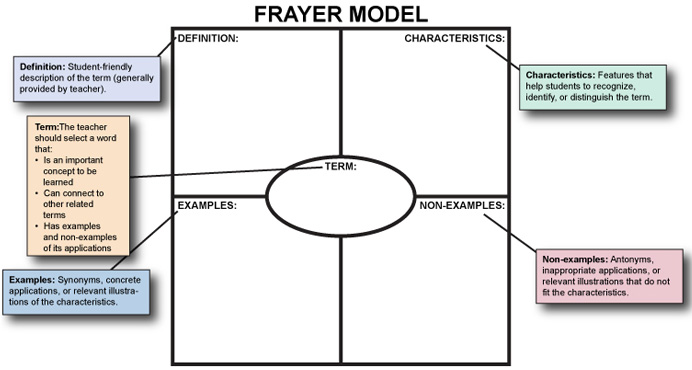
Frayer Model
I found the Frayer Model to be a valuable
graphic organizer for students to build vocabulary and conceptual knowledge. It
allows teachers to incorporate the four elements for effective vocabulary instruction
in one organizer. I think that having the “non-examples” section in this
graphic organizer is extremely helpful for students because it debunks any
assumptions that students may have about the vocabulary word. It visually shows
students the definition of the word, characteristics of the word, examples, and
non-examples. Like all graphic organizers, teachers need to model how to use it
and explain the importance of it. Over time, students may work in groups to
complete the organizer and gain a deeper understanding of the terms by
discussing how they came up with examples or non-examples.
http://iris.peabody.vanderbilt.edu/module/sec-rdng/cresource/q2/p07/sec_rdng_07_link_frayer_types_02/#content
QAR
As a first grade teacher,
this is the first time I have learned about QAR. I have heard about it because
teachers in my district frequently use this strategy. However, I never
understood exactly what the benefits were. After reading the article, “Using
Collaboration, Co-Teaching, and Question Answer Relationships to Enhance
Content Area Literacy,” I was amazed. “The QAR strategy can enhance
comprehension across a variety of content areas and can encourage the use of a
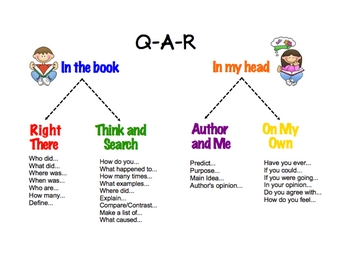
common language for strategy use throughout the school day” (Fenty, McDuffie-Landrum & Fisher, 2012). This strategy teaches students that there are two
ways to find the answers to comprehension questions. The answers are either “in
the book” or “in my head.” The answers to these questions are further broken
down into “right there” or “think and search” for “in the book” answers. “In my
head” is further broken down into “author and me” or “on my own.” I love this idea because not all answers will
be found directly in the text and this is a great strategy to get students to
think about their own answers. Furthermore, this strategy is helpful to all
students including students with learning disabilities.
References
Fenty, N.,
McDuffie-Landrum, K. and Fisher, G. (2012). Using collaboration, co-teaching,
and question answer relationships to enhance content area literacy. Teaching
Exceptional Children, 44(6), pp.28-37.
Iris.peabody.vanderbilt.edu, (2016). IRIS | Seconday
Reading Instruction (Part 1): Teaching Vocabulary and Comprehension in the
Content Areas. [online] Available at: http://iris.peabody.vanderbilt.edu/module/sec-rdng/cresource/#content
[Accessed 15 Feb. 2016].
